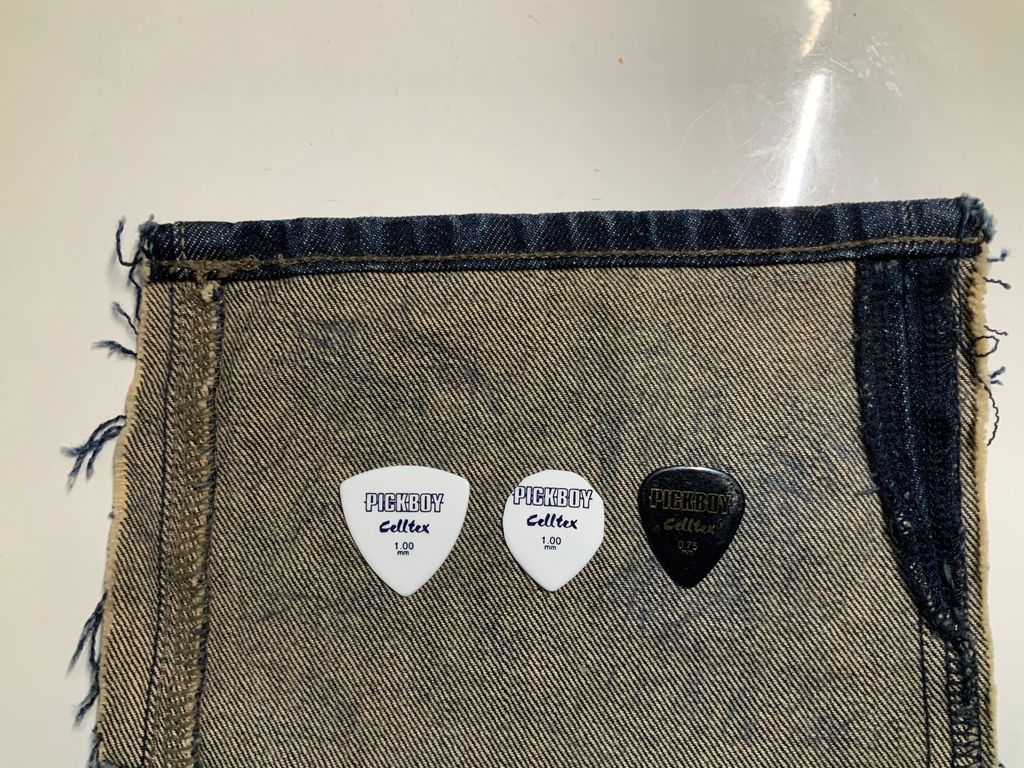

teardrop
Standard shape that makes it easy to grasp the position of the tip. Suitable for those who want to try out various ways of playing both chords and single notes.
For people like this: I want to try the standard first.
See teardrop shapeWhether it's your first guitar pick or the one you want to try next.
Find the PICKBOY that suits you based on shape, thickness, and material.

First of all, use Medium as the standard since it has a good amount of flexibility.
Whether you play a chord or play one note at a time, this is the starting point for checking the difference in playing feel.
Even if the thickness is the same, the feel will change depending on the material and shape. The numbers are a guideline for selection.
Standard shape that makes it easy to grasp the position of the tip. Suitable for those who want to try out various ways of playing both chords and single notes.
For people like this: I want to try the standard first.
See teardrop shape
For those who want to check how easy it is to hold because it has a wide grip area. It also features a shape that allows you to use three corners.
For these people: Small picks are difficult to hold.
See triangle shapeFor those who would like to search for other options such as smaller shapes.See the pick shape in detail
If you are concerned about it getting caught on the strings, use a thinner one. If you want more texture, go for something thicker. If you compare the same shapes and materials, it will be easier to see the differences.
~0.5 mm
For those who want to play chords with a light touch while feeling the bend.
See the Thin0.6~0.8mm
For those who want to find their own standards while trying both chords and single notes.
View Medium0.9~1.2mm
For those who want to suppress bending and feel the response when playing single notes or leads.
View Heavy1.2 mm or more
For those who want to finely adjust the movement of the pick with a stiff feel.
Extra See HeavyThe thickness classification is a guideline. 1.2mm is listed as Heavy and Extra Heavy, so please check the thickness and classification on each product page.
Even if the shape and thickness are the same, the feeling of bending and string separation will vary depending on the material. First of all, there is one material that interests me. Once you get used to using it, you can enjoy the difference between it and other materials.
For those who want to try out standard materials. Try using your own touch to check how it bends and how it fits your fingertips.
See CelluloidFor those who want to compare the feel of string separation. It will be easier to tell the difference if you try something close to your usual shape and thickness.
See PolyacetalFor those who are concerned about a flexible feel. While playing the chords, check how flexible it is and how easy it is to hold.
See NylonLet's take a closer look at the differences between the materials.Go to the guitar pick material guide
If you try using it and feel that it is a little thinner and easier to hold. Let's compare the shapes, thicknesses, and materials by changing just one element that interests you. You can gradually find the PICKBOY that suits you.
First, choose a teardrop-shaped Medium (approximately 0.6 to 0.8 mm). If you feel that it is too small to hold, try comparing the triangular type.
Don't just choose an instrument based on its name; choose based on how it plays and how it feels. You can also start with Medium and compare it by choosing the thinner one for light chord strokes, and the thicker one if you want the feel of a single note.
If you are looking for your favorite, it will be easier to feel the difference if you compare two or three types that differ only in thickness. We recommend trying one at a time rather than changing the shape, thickness, and material all at once.
It's okay if you don't choose perfectly from the beginning.
Why not start by searching for a PICKBOY that suits you on Medium?
A video series in which Tomo Fujita, professor of guitar at Berklee College of Music, talks about choosing a pick and how to hold a pick. You can also check the sound of the pick through actual performance.
Watch the video series